Showing posts with label 303. Show all posts

Saturday, November 12, 2011

Teacher examples for the Thinking Beyond the Material lesson plan.


To make these I used Post-its, Poland Spring Bottles, and Rubber Bands

Tuesday, October 25, 2011

Ten Minute Presentation: Tara Donovan & John Dahlsen

Transcending the Material

Here is a link to our Prezi presentation of the artists Tara Donovan and John Dahlsen. The top link is the final presentation but I am also including our research and outline version that helped us get to the final Prezi.

Scaffolding questions to go along with Final Presentation.

Monday, October 10, 2011

John Dahlsen

Environmental Installation Art

These Installation art works are a combination of two primary elements that make up my recent work.The wall works are large scale high resolution digital prints on canvas. The floor piece is made from the found plastics. One mimicking the other.

Primary Installation
Black Plastic Installation


 Contemporary environmental art installation, made from found plastic objects and nylon rope. Recycled art created from plastics collected from Australian beaches

Catch


Vessel

Womb
 

Tara Donovan

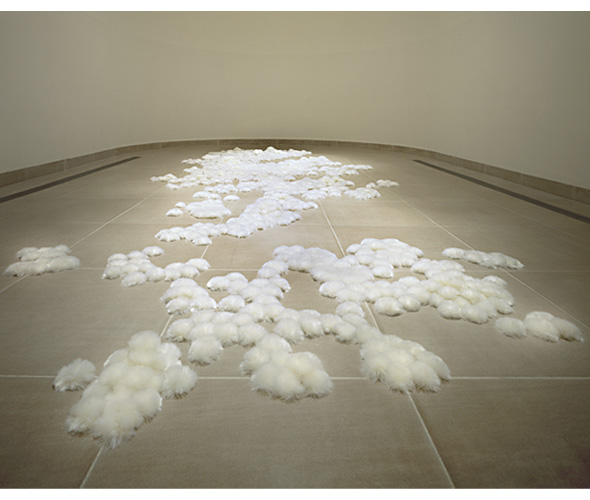
For over a decade, American sculptor Tara Donovan has transformed huge volumes of everyday items into stunning works of phenomenal impact. Layered, piled, or clustered with an almost viral repetition, these products assume forms that both evoke natural systems and seem to defy the laws of nature. Donovan explores how a single action applied to a single material countless times can transcend our expectations. Creating astonishing visual experiences, the artist's work invites closer looking and bigger thinking about the everyday materials that surround us.
Haze (detail)
Haze, 2003
Stacked Clear Plastic Drinking Straws
12' 7"(H) x 42' 2"(W) 7 3/4"(D)
Ace Gallery New York
Lure, 2004
Fishing Line
2 1/2"(H) x 10'6"(W) x 26'(D)
UCLA Hammer Museum, CA
Untitled (detail)
Untitled, 2003
Styrofoam Cups, Hot Glue
Dimensions Variable
Ace Gallery Los Angeles, 2005
 
Untitled, 2003
Paper Plates, Glue
3 1/2'(H) x 4'(W) x 9'(D)
Ace Gallery Los Angeles, 2005
She employs everyday objects such as drinking straws, buttons or No. 2 pencils to create large-scale sculptures and prints that take on a life (and light) of their own. She allows the shape of the chosen material to determine the form of the piece until it becomes magically other (think vast moonscape in Styrofoam cups), managing to transcend both materiality and gimmickry in a culture that celebrates both.

Tara Donovan Slideshow

TMagazine Article

Tuesday, September 20, 2011

Post Modern Themes and Middle School Curriculum

I found that I was more interested in the articles concerning Post Modern Principles than I was in the ideas brought forth in the Middle School Curriculum article. However I do understand the importance of the concerns that were addressed in the M.S.C. article. From these ideas I thought the most influential was making the curriculum more focused on what students are interested in personally in an effort to get them to understand how those interests can branch out into a more active interest in similar themed social issues. This idea of curriculum can most certainly extend beyond that of the middle school environment and be used as a basis in other grade levels. Using this aspect of a personally planned curriculum pairs nicely to the themes that were presented in the Post Modern Principles article. Working from the basic concept of the elements and principles of design that were implemented so long ago it makes sense that in such a visually stimulated society we can address more complex themes to create an understanding of visual culture. I think it might also be interesting to think of ways that the elements and principles of design that included; line, space, color, texture, and value, can be examined in a more interesting way by associating these ideas with more complex concepts. The following video expands on this idea and gives visual examples of how this could work to modify the elements and principles of design.

 
Art Education after Art Education: A Postmodern Look at Elements of Design

Tuesday, September 6, 2011

Exquisite Rorschach Game

Within the variety of art historical Surrealist games I find that I am most drawn to the visual aspects of the games; Exquisite Corpse and Decalomania (with reference to Rorschach ink blots). I think it would be interesting to combine these games together. Combining the games there is direct play with chance as well as automating drawing created from the ink images. The reason I believe this would be beneficial as a game is that when chance is used to create an image as it is with the concept of Rorschach tests many parts of that image will spark new ideas and we are able to find familiar shapes within the ink.

For example within a common Rorschach ink blot:


Specific to this image various people would find completely different shapes created in the ink. I see two sea horses and a puppy just to point out a few images I am deciphering in the ink.

The images that can be found or parts of shapes that are started are what I find so interesting about Rorschach tests. With this in mind I think pairing this exercise with the basic concept of the exquisite corpse game will create an especially interesting outcome.

Visual Exquisite Corpse Examples

The way I would use the two Surrealist games together would be to begin with the ink image. After the image has be created students will spend time deciphering the shapes they can find within the ink image. The use of the exquisite corpse concept comes into play with the students begin to draw or outline the shapes they find within the ink images. These drawings of the chance shapes that occur will be kept private so other students will not influence what their peers see within the ink. After students have exhausted the amount of images they can find within the ink blots, presenting what they have found will be extremely interesting for students to see what their peers have seen in the images of the ink.

This is an example of finding and image within the ink:

Using chance in the surrealist play alongside drawing of deciphered images will make this game more than just an individual experience, being able to show each other in a fun informal setting can open other students up to seeing things in new ways and become more comfortable with sharing work.

Images created in this process can be used to pursue larger work with examining a specific part of the ink image and what was deciphered within it.