Monday, October 10, 2011

John Dahlsen

Environmental Installation Art

These Installation art works are a combination of two primary elements that make up my recent work.The wall works are large scale high resolution digital prints on canvas. The floor piece is made from the found plastics. One mimicking the other.

Primary Installation
Black Plastic Installation


 Contemporary environmental art installation, made from found plastic objects and nylon rope. Recycled art created from plastics collected from Australian beaches

Catch


Vessel

Womb
 

Tara Donovan

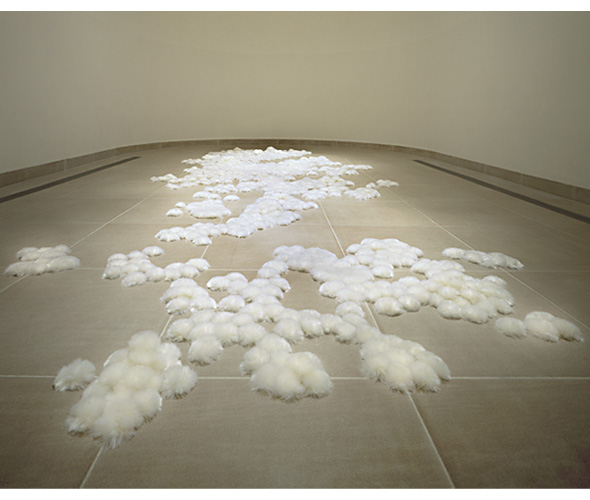
For over a decade, American sculptor Tara Donovan has transformed huge volumes of everyday items into stunning works of phenomenal impact. Layered, piled, or clustered with an almost viral repetition, these products assume forms that both evoke natural systems and seem to defy the laws of nature. Donovan explores how a single action applied to a single material countless times can transcend our expectations. Creating astonishing visual experiences, the artist's work invites closer looking and bigger thinking about the everyday materials that surround us.
Haze (detail)
Haze, 2003
Stacked Clear Plastic Drinking Straws
12' 7"(H) x 42' 2"(W) 7 3/4"(D)
Ace Gallery New York
Lure, 2004
Fishing Line
2 1/2"(H) x 10'6"(W) x 26'(D)
UCLA Hammer Museum, CA
Untitled (detail)
Untitled, 2003
Styrofoam Cups, Hot Glue
Dimensions Variable
Ace Gallery Los Angeles, 2005
 
Untitled, 2003
Paper Plates, Glue
3 1/2'(H) x 4'(W) x 9'(D)
Ace Gallery Los Angeles, 2005
She employs everyday objects such as drinking straws, buttons or No. 2 pencils to create large-scale sculptures and prints that take on a life (and light) of their own. She allows the shape of the chosen material to determine the form of the piece until it becomes magically other (think vast moonscape in Styrofoam cups), managing to transcend both materiality and gimmickry in a culture that celebrates both.

Tara Donovan Slideshow

TMagazine Article

ArtsEdge : Show and Tell

ArtsEdge: The Kennedy Center


ArtsEdge at the Kennedy Center is an online resource for Educators, Families and Students. It includes all arts, music, theater, dance and visual arts. It includes lessons, history of the arts, how-to's, articles for educators, families and students about the arts and arts education. This is a tool that everyone could use to expand their knowledge of the arts as well as helping to create lesson ideas. Students can watch videos and learn about a variety of visual and performing arts with interactive sites.


Because ArtsEdge is created by the Kennedy Center for the Performing Arts, music, dance, and theater are the focus however there are many resources for the visual arts as well if you take the time to search for them.

Gambiologia, the Brazilian art and science of kludging

Gambiologia 

"Gambiarra is the Brazilian practice of makeshifts, the art of resorting to quirky and smart improvisation in order to repair what doesn't work or to create what you need with what you have at your disposal. Gambiologia is the 'science' that studies this form of creative improvisation and celebrates it by combining it with electronic-digital techniques... There is no exact translation for 'gambiarra' so we initially used kludge which means (from Wikipedia): 'a workaround, a quick-and-dirty solution, a clumsy or inelegant, yet effective, solution to a problem, typically using parts that are cobbled together'. In the US they'd call it makeshift. Gambiologia is the study of 'gambiarra' in a technological context."

I've included the collectives website along with a website that shows examples of basic kludging being done all over the world. It gives a basis for understanding the "makeshift" quality that this collective is interested in. 
www.gambiologia.net
(North American way: thereifixedit.failblog.org )
Audio Cable fixed with candy wrapper
Car Mirror
Using a bottle for a Shower

Gambiologia is also a group of artists that create works in exhibits based on kludging. They range from very simple to extremely complex creations.
Some of the work includes:

Paulo NenflĂ­dio, Polvo, 2010
Polvo (Octopus) from Paulo Nenflidio is a sound machine made by plastic conduits. These are originally used to hold electric cables but Paulo used them to hold compressed air. As the visitor "plays" a keyboard made out of door ring bells, the conduits blow, generating different sounds. The seven bells form a complete tone set. This bizarre octopus-instrument still have an 8th note generated by an water spray on its top.

Guto Lacaz, Furadeiras.
 Furadeiras (Drills) is one of the simplest exhibited artworks but surely one of the smartest. It's by Guto Lacaz, an experienced artist from Sao Paulo. He proposed an unusual meeting between "different generation" drills - one being analogue and the other electrical. It's an ironic interpretation between planned obsolescence and how technology evolves, sometimes just rotating around itself in an infinite loop. Or how the old (low-tech) and the new (high-tech) can live collaboratively.

Coletivo Gambiologia (Fred Paulino, Ganso and Lucas Mafra), Gambiociclo, 2010
I always wish to have a multimedia vehicle that could project video and digital graffiti in public space. It's terrific how that can be a straight path to a democratic dialogue between people and the city itself. But our MBU should be gambiological - reflecting the logics and aesthetics of 'gambiarra' with this strong Brazilian accent. So we built it inspired by trolleys of salesmen who ride here mostly selling products or doing political advertisement. The idea was to mix performance, happening, electronic art, graffiti and 'gambiarras'.

"Gambiologia was initially the name our three guys' collective but the word is now being used here to identify a new way of think about technology, hacking and (Brazilian) pop culture. Like a science or a movement... It somehow captured the feeling of many creators... As a colonial country (Brazil) we initially didn't have enough resources for solving everyday problems so we had to invent simple and cheap solutions... Gambiologia tries to go beyond this, bring it into the art scene with an aesthetical and political discussion about technology."

This idea is new media literacy because it is breaking apart, recycling, remixing and re-purposing technology to create something new or make a fix it that happens spontaneously. You learn about the technology by taking it apart and making new additions. I think this is really interesting and am very drawn to how much this idea includes. The fact that it started as something that everyone can do and probably has done, by making small adjustments with random materials to create a solution to a problem, to using these ideas to create art by mixing technology for what the actual purpose is and what the artist wants to create.

Confronting the Challenges of Participatory Culture

This last reading was pretty lengthily, but from reading it I got that there was a big part that focused on whether or not using technology in the classroom would be effective because of the students ability to comprehend abstract thinking. One part in particular stated that it was worrisome that if you used a video game like Civilizations in the classroom whether the students would see the plot and actions of the video game as historical fact. This got me thinking of a story my friend had told me recently about his dad in grade school.


He told me that his dad was in grade school when people came in from the census bureau or something like that to interview the elementary students. They used cartoon characters as references when asking students about violence and other topics. The part that interested me was that he said his dad was pretty confused when being interviewed, the grown-up was using cartoon characters to explain real life behavior to the students but he understood that but knew that the actions in cartoons were unreal and couldn't happen in real life so as an elementary school student didn't understand why an adult was using cartoon characters to explain real life. The way my friend explained it to me was that the children can think abstractly to an extent, they know that they things on cartoons are not real and can't happen outside of the television. For example; a kid knows that just because hes seen in on television, an animal can't get run over by a car and be flattened just to get back up and walk around again.

This story made me think that perhaps adults under estimate the abilities of children. I think that is exactly what is happening in that section of the article where they worry that students will think what is on the video game is real. I wouldn't be worried about that, students have a previous knowledge of what a video game is and know that they are not real, the ideas and concepts may be based on fact but since the player is in control of the events, they do not mirror real life.
For example; using the video game Civilizations, students choose to be a world leader and help cultivate a civilization from cave men to space age. The game is not meant to teach world history, its meant to teach the concepts on civilizations, research, diplomacy, war, culture. I believe it is underestimating students by assuming that they would consider everything they are told to be true. From the story about cartoons it seems clear that children are able to separate whats real and what is unreal at an early age, that just because they see it on television doesn't make it true, that there is a concept called fantasy which bases stories on made up ideas.

I think it would be beneficial to bring games that taught things like the game Civilizations into the classroom, not to teach a subject but to aid in the students understanding of how these concepts they are learning about can be applied to everyday life.

To have a better understanding of the game Civilizations, here is a trailer giving the basic concept:

Monday, September 26, 2011

Dear Sophie


Google Chrome came out with a new commercial to promote their software. With all the talk of technology and the way if effects lives in class tonight it reminded me of some commercials that I've seen recently. What intrigued me the most about this was how it was basically making a digital scrapbook of a child's life.  The use of Google Chrome in replace of a traditional aspect of recording events, such as scrapbooking and old-school VHS home videos, is just another way that technology is taking over. Part of this that really interests me is how with having so much invested digitally does that devalue physical media like actual photos, a scrapbook, and hand written letters or does it place more of a worth on putting the time in to actually create an object outside of digital technology?

For me I find that hand made items have more of a value since so much is online and in the digital world. There is something "homey" in a hand made item that has associations of caring and love that gets lost with how technical and inhumane digital items can be found.

Sunday, September 25, 2011

Self Portrait


If you've ever heard the saying, "you can take the girl out of the _________, but you can't take the _________ out of the girl" then you will understand the concept of even though you change something about the place your in or what you do it never really changes your true nature. With aspects of identity I choose to depict that very saying within the image. No matter how far away I go from the northern Adirondacks I don't lose what I've learned from growing up on the shores of the lakes and in the mountains. Our lives are changing all the time, graduating from high school, then college, going on to start something new, all of these milestones change where we are and what were doing but they don't change who a person is. Some people, like myself, really care about where they came from and grew up, how it effected their family life and continues to effect who they are now. To go back to my version of that popular saying; you can take the girl out of the mountains, but you can't take the mountains out of the girl.